

The Hobby That Has Moved Into the Garage
For households with active hobbies — woodworking, cycling, skiing, kayaking, camping, climbing — the garage frequently becomes the hobby’s headquarters whether or not it was designed for that purpose. The result is typically a space that serves the hobby imperfectly: not enough specialized storage for the equipment, inadequate workspace for the activity, and the hobby and general household storage competing for the same space in ways that make both work less well.
A garage organized deliberately around a specific hobby — rather than a general storage space that happens to contain hobby equipment — produces a space that genuinely enables the activity rather than just storing its equipment.
Woodworking: Tool Storage and Chip Management
A woodworking garage needs to address three specific challenges that general storage organization doesn’t: tool accessibility during active work (tools in use need to be within reach of the work surface, not in a distant cabinet), wood storage that keeps boards flat, organized by species and dimension, and accessible without moving everything else, and dust and chip management that prevents sawdust from coating every surface in the garage and migrating into the home.
The French cleat wall system (covered in detail in Vol. 7 of this series) is particularly well-suited to woodworking tool organization because it allows tool holders to be positioned close to the work area and repositioned as the workflow evolves. Lumber storage on wall-mounted horizontal racks or a dedicated lumber cart keeps boards organized and dry. Dust collection integrated with stationary tools (a shop vacuum or dedicated dust collector connected to each tool with flexible hose) controls chip dispersion at the source.
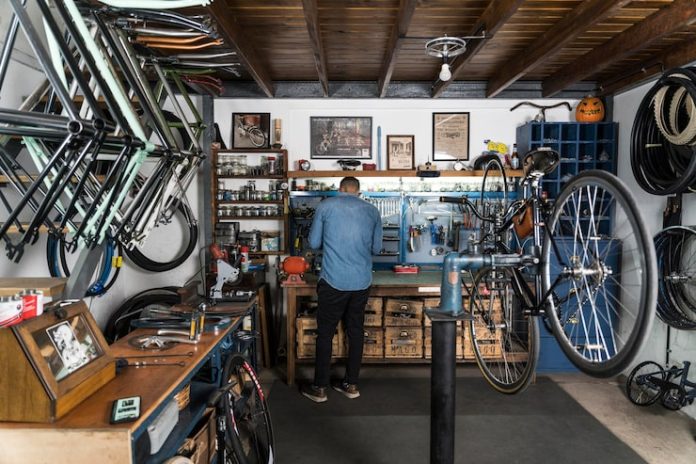
Cycling: Vertical Storage That Protects the Investment
A road bike, mountain bike, or e-bike represents a significant investment that deserves storage protection — not leaning against a wall where it collects scratches and takes up floor space, but hung or stored in a way that protects the frame, keeps the bike accessible for frequent use, and minimizes its floor footprint.
Horizontal wall mounts (hooks that cradle the bike at the top tube or by one wheel) position the bike parallel to the wall in a small footprint. Vertical wheel hooks (a single hook that holds the bike by the front or rear wheel in a vertical orientation) require even less wall width. Ceiling pulley systems allow the bike to be raised fully overhead — maximum floor space recovery at the cost of slightly more effort to raise and lower. For multiple bikes, a dedicated bike storage unit (freestanding rack that holds 2–4 bikes in a compact floor footprint) organizes multiple bikes without multiple wall mounting positions.
Seasonal Sports Equipment: Zone-Based Storage
Households with seasonal sports equipment — skis and ski boots, snowboards, golf bags, tennis rackets, baseball equipment, water sports gear — face the challenge of equipment that’s used intensively for a season and stored for the remainder of the year. General storage mixed with everyday items makes seasonal retrieval frustrating; dedicated seasonal zones make it straightforward.
The seasonal zone approach: designate a specific wall or section of wall for each sport’s off-season equipment. Ski and snowboard wall racks hold equipment vertically and protect edges; golf bag stands keep bags upright and accessible; water sports equipment (paddleboards, kayaks, surfboards) on dedicated wall or ceiling mounts. At season end, equipment returns to its designated zone after cleaning and any necessary maintenance — the storage location doubles as the equipment maintenance reminder.
The Shared Garage Problem: When Multiple Hobbies Compete
In households with multiple active hobbyists sharing one garage, the organizational challenge is creating dedicated zones for each hobby that don’t interfere with each other’s use of the space. A woodworking zone with stationary tools competes with a cycling zone that needs to access the workbench for repairs; both compete with the car that also needs to park there.
The three-dimensional solution: vertical differentiation (ceiling height used for seasonal and infrequent storage, wall space for each hobby’s dedicated zone, floor space for active work and parking) separates competing uses into different planes. A rolling workbench that stores against the wall and rolls out for use creates a deployable work zone that doesn’t permanently occupy floor space. Zone boundaries (marked with floor tape or defined by the storage systems themselves) create visual clarity about whose space is whose.